Viksit Bharat 2047

Viksit Bharat 2047: Why the Clock Is Already Ticking

Greetings on Republic Day

Viksit Bharat by 2047” should not be treated as a slogan. It is a survival-grade national milestone, because India’s demographic clock will not wait for our slogans, our comfort, our politics, or our celebrations.

More than two decades ago, when I first ideated the thought of Viksit Bharat, it came from a simple but urgent reality: by around 2045, roughly one out of five Indians will be a senior citizen. A nation where a fifth of the population is elderly will face a very different economic equation. Spending on health, care, pensions, and support systems will rise sharply. For many in that age group, earnings will be negligible or absent. This means fewer earners will have to support more dependents-financially, emotionally, and institutionally.

If India does not become Viksit latest by 2047—then we may never become Viksit in any meaningful sense. Not because India lacks potential, but because the cost of delay will become unmanageable. A late start is not a slow start; it is a strategic failure.

So the question is not whether India wants to be Viksit Bharat by 2047. The question is whether India is building the constants that make a nation developed—starting now.

The Most Important Constant: Who Is a Bharatiya?

Before we define GDP targets, technological achievements, or global rankings, we must define the most important constant of Viksit Bharat: Who is a Bharatiya? Who is an Indian?

What are the qualities and attributes that define an Indian citizen in a Viksit Bharat? Integrity? Discipline? Empathy? Respect for public property? Scientific temper? Responsibility? Civic sense? Ability to collaborate? Commitment to learning? If we do not define the “Indian” we want, then every development plan will remain a political jargon and an administrative exercise, never a people’s movement.

A nation becomes developed when its citizens embody development in everyday conduct. Viksit Bharat is not just an economic state; it is a cultural revolution first!

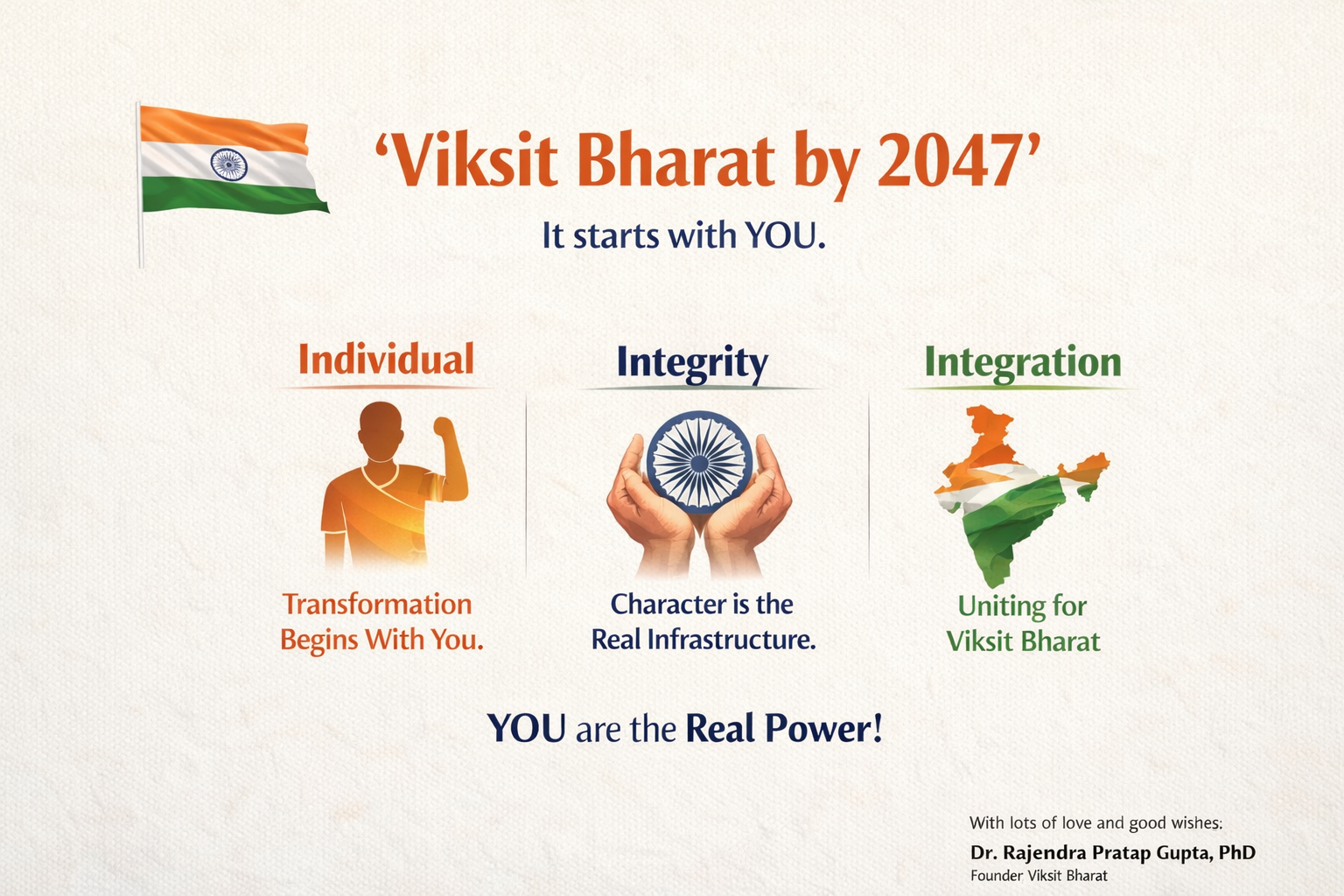
And here is where one simple idea becomes powerful: the alphabet “I” in India—and in the spirit of being Bharatiya—must stand for three things: Individual, Integrity, and Integration of the goal of VIKSIT BHARAT.

Individual: because transformation begins with one person taking responsibility.
Integrity: because no nation becomes developed on shortcuts, corruption, or dishonesty- character is the real infrastructure.
Integration: because the goal of Viksit Bharat must be integrated into our daily choices, institutions, and behaviours—not treated as an occasional campaign.

Bottom-Up, Not Top-Down

We must stop believing that Viksit Bharat can be achieved top-down through sloganing, branding, and symbolic campaigns. Creating “Viksit Bharat Ambassadors” will not create Viksit Bharat. A country cannot outsource development to a few chosen faces. Development is not a photo-op; it is a daily practice.

Viksit Bharat will be built bottom-up:

First Viksit Village, thenTehsil/Taluka, then Viksit City & District, and Viksit State—and only then Viksit Bharat goal can be realised. Same we need to do for every sector-domain. But above all, it is ‘I’ , then Individual that will drive the above, and that is ‘You’

This is not just administrative sequencing. It is the only scalable model. Because development that doesn’t reach the last mile is not development—it is an illusion. We need to go back to the drawing board for our economic and administrative model.

Patriotism Is a Deed, Not a Post

Do not assume that sharing Republic Day or Independence Day messages will make India Viksit Bharat. That is not patriotism. Patriotism is not merely singing a song. Patriotism is doing a deed.

Every time you do a deed—an honest deed, a civic deed, a responsible deed—you are, in effect, singing the national anthem. Let us commit to one small deed every day for Viksit Bharat. Keep your street clean. Be punctual. Pay taxes honestly. Respect queues. Mentor one person. Teach one child. Save water. Report corruption. Don’t offer bribes. Don’t tolerate incompetence. Don’t damage public property. These are not “small” things—these are the atoms of nation-building.

The Power of “I” in India

Viksit Bharat is an individual Abhiyan. If 144 crore people cannot make India Viksit Bharat, who else will?

The real power is the power of “I”—the Individual acting with Integrity, and integrating the mission of VIKSIT BHARAT into everyday life. Not in ads. Not in hashtags. Not in expensive campaigns. But in real work, repeated daily, across millions of lives.

Let us stop performing patriotism and start practicing it. Let us stop sloganing and start building. That is how we will create Viksit Bharat—well before 2047.

This has been my favourite poem and it should be yours too, if you want a Viksit Bharat because – ‘You’ are the Real ‘Power’.

One song can spark a moment,
One whisper can wake the dream.
One tree can start a forest,
One bird can herald spring.

One smile begins a friendship,
One moment can make one fall in luv.
One star can guide a ship at sea,
One word can frame the goal

One vote can change a nation,
One sunbeam lights a room
One candle wipes out darkness,
One laugh will conquer gloom.

One step must start each journey.
One word must start each prayer.
One hope will raise our spirits,
One touch can show you care.

One voice can speak with wisdom,
One heart can know what’s true,
One life can make a difference,
You see, it’s up to you!

With lots of love and good wishes

Dr. Rajendra Pratap Gupta, PhD
Founder
Viksit Bharat
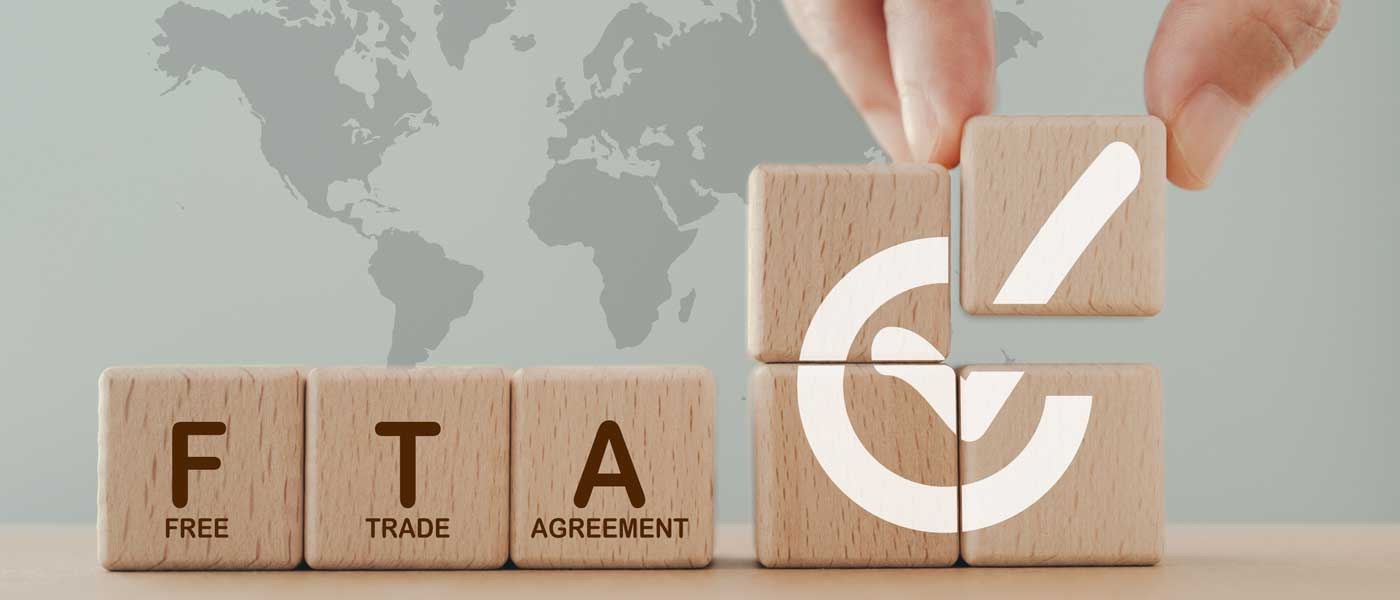
Trap Deals or Trade Deals- We Must Scrap Them!

Trap Deals or Trade Deals- We Must Scrap Them!

Trade agreements have yielded undeniable benefits for developed economies, including higher growth rates, better market access, and expansion of global value chains. However, several clauses and real-world case studies demonstrate how these deals frequently disadvantage low-income countries, often leading to harm rather than help. Developed nations and that too, mostly the United States have various mechanisms like the United Nations, IMF, WTO and World Bank to seduce the poorer nations with dole outs or reports on their ‘dream growth strategies or with institutional reforms’ or to cajole them into submission, and finally, grab their resources and if nothing works, change the regimes to get what they want through institutions like the CIA & earlier the USAID or the US Embassies in various parts of the world.

Of course, there are promising alternative strategies for poorer nations to foster prosperity outside conventional trade agreements.

Data: How Trade Deals Benefit Developed Nations

  • According to BCG’s Trade Engagement Index, countries like the United States, Germany, and Japan possess the most extensive preferential trade access, enabling their companies to manufacture at lower costs and dominate global markets.[1]
  • About two-thirds of estimated annual gains from eliminating all merchandise trade barriers, roughly $250 billion to $680 billion, would accrue to industrialized countries.[2]
  • Foreign Direct Investment (FDI) trends reveal that developed economies receive the bulk of investment flows stemming from trade deals, amplifying their competitive advantage and reinforcing existing economic structures.[1]
  • Rich countries also utilize trade deals to secure access to strategic sectors and advanced technology, further entrenching their lead over developing economies.[1]

Clauses That Favor Developed Nations

Tariff Escalation: Developed countries frequently implement tariff structures that increase with value addition. For example, raw coffee from Africa might enter Europe at low tariffs, but processed coffee incurs heavy import taxes, restricting industrial development in exporting countries.[2]

Restrictive Quotas and Subsidies: Agricultural subsidies in the US and EU make it impossible for developing countries to compete. High quotas ensure poor nations cannot export significant volumes beyond set limits.[2]

Intellectual Property Provisions: WTO’s TRIPS agreement demands high patent protection, which blocks affordable medicine access and technology transfer for poorer nations.[3]

Labor and Environmental Standards: Some agreements impose complex standards that poorer nations struggle to meet, effectively keeping their goods out of developed markets or increasing compliance costs.[4]

Dispute Resolution Mechanisms: Investor-state dispute settlement (ISDS) clauses often allow multinational corporations, mostly based in rich nations, to sue poor countries in international courts, further tilting the balance of power.[3]

Evidence: Trade Deals Harm Low-Income Countries

US Cotton Subsidies: American farm subsidies drove down cotton prices, with West African producers (Benin, Burkina Faso, Mali, Chad) losing billions in export revenues and facing rural poverty spikes.[5][2]

G20 Financial Barriers (2008-2010): 692 new trade barriers disproportionately hit poorer nations, with 40% of the global impact hurting the most vulnerable economies, costing 141 nations significant growth opportunities.[6]

Costa Rica and Asia: Poor countries like Costa Rica, Bangladesh, and Sri Lanka have suffered when free trade agreements forced domestic industries to compete with subsidized goods from richer countries, leading to layoffs, lower wages, or collapse of local businesses.[6]

Textile Sector Losses: OECD quotas and tariffs resulted in annual welfare losses of nearly $20 billion for developing countries, triple the losses from import restrictions on textiles and clothing.[7]

Alternative Pathways: How Poor Nations Can Prosper

We must consider the fact that Africa is rich in natural resources, right from diamonds to cocoa and yet, it is labelled a ‘dark continent’ and still remains in the category of LICs / LMICs. Same for most part of the world outside this block of these ‘bullying nations’ desperate to sign these ‘trap deals’. One should look at the press releases of the leaders from these countries after the trade deals are signed

Look at the data of the global GDP and global debt.

  • The estimated global nominal GDP is about US $117.17 trillion. 
  • Total global debt (public + private) reached approximately US $251 trillion at end-2024, which is over 235 % of global GDP. 

The western economic model has created at ‘debt fuelled’ economy and not a ‘demand driven & sustainable’ economies. These economic models are not sustainable. So, we have to move on from the theoretic economic models of the west and create a new ‘Distributed Growth Model’ that is demand based. (Ref: book; Your Vote is Not Enough, Dr. Rajendra Pratap Gupta, 2019).

Every LMIC must develop an economic model that suits its strengths and weaknesses. The model should be a decentralized one, that caters to the local community and provincial needs in a collaboration manner.

Domestic Priorities: Countries should focus on raising domestic productivity and income (GDP per capita). Then, creating an ecosystem that supports entrepreneurship.

German Mittelstand is a good model to look. (Reference:  https://swarajyamag.com/economy/make-in-bharat-is-the-need-of-the-hour)

Plan for capital and improving financial markets to reduce reliance on external aid or unfair trade deals.[8]

Regional Economic Integration Forming regional blocs (like the African Continental Free Trade Area) empowers developing countries to negotiate better terms collectively, diversify economies, and build shared infrastructure.[9]

Strategic Protectionism: Temporary tariffs and subsidies to nurture infant industries—as South Korea successfully did—can help countries grow competitive sectors before opening to global competition.[9]

Promoting Remittances and Investment: Encouraging foreign remittances and direct investment outside trade deals can stimulate sustainable development.[8]

Strengthening S&D Provisions: Advocating for enhanced “Special and Differential Treatment” clauses at the WTO would provide low-income nations the policy space needed for long-term economic planning.[9]

Data and Knowledge Building: Investing in trade analytics and capacity-building empowers policymakers to make informed decisions, ensuring better negotiation and utilization of available trade frameworks.[10][4]

Developed countries reap an outsized share of trade deal gains, while clauses embedded within agreements often act as stumbling blocks for poorer nations. Real-world cases show that low-income countries can be harmed by unbalanced deals, but alternative steps—focusing on strategic internal development, strategic regional alliances, and selective protectionism—offer pathways to true prosperity. Equitable reforms to the global trade system are essential if trade is ever to fulfill its promise as a genuine engine of shared growth. For every developing country, the choice is between; Choosing a broken economic model or creating a robust development model!

Sources

[1] Economies Benefiting Most from Free Trade Agreements https://www.bcg.com/publications/2024/economies-benefiting-most-from-free-trade-agreements

[2] Global Trade Liberalization and the Developing Countries https://www.imf.org/external/np/exr/ib/2001/110801.htm

[3] Negotiating free-trade agreements: a guide https://www.oas.org/dsd/Tool-kit/Documentos/ModuleV/Goode%20Reading%20Chapter%203.pdf

[4] 5 ways to make global trade work for developing countries https://www.weforum.org/stories/2016/09/global-trade-developing-countries-unctad/

[5] Do Poor Countries Lose Out as a Result of Free Trade Agreements? https://www.ijraset.com/research-paper/do-poor-countries-lose-out-as-a-result-of-free-trade-agreements

[6] [PDF] The Detriments of Free Trade on Developing Countries https://theartsjournal.org/index.php/site/article/download/2131/1012/8724

[7] Trade and development https://en.wikipedia.org/wiki/Trade_and_development

[8] A Tale of Two Paths https://www.csis.org/analysis/tale-two-paths-0

[9] Alternatives to the Current Global Trade System and Regime  https://www.tni.org/en/article/alternatives-to-the-current-global-trade-system-and-regime

[10] How countries are using better data to increase trade https://www.worldbank.org/en/news/feature/2019/06/27/how-countries-are-using-better-data-to-increase-trade

[11] International Trade: Commerce among Nations https://www.imf.org/en/Publications/fandd/issues/Series/Back-to-Basics/Trade

[12] Trade and Globalization https://ourworldindata.org/trade-and-globalization

[13] International (Global) Trade: Definition, Benefits, and … https://www.investopedia.com/insights/what-is-international-trade/

[14] Enabling clause https://en.wikipedia.org/wiki/Enabling_clause

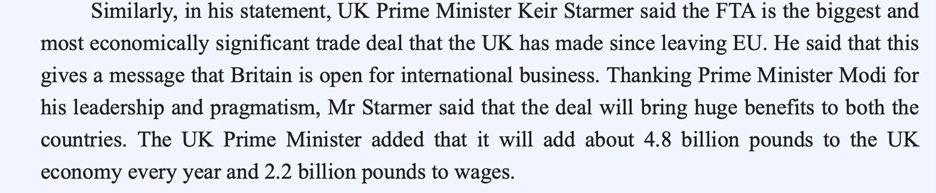
[15] India–UK CETA https://www.pib.gov.in/PressNoteDetails.aspx?NoteId=154945&ModuleId=3

[16] 6. The Status of Trade Preferences in WTO https://www.fao.org/4/y2732e/y2732e08.htm

[17] Globalization and the Benefits of Trade https://www.chicagofed.org/publications/chicago-fed-letter/2007/march-236

[18] Trade Agreements – Benefits, Types & Global Impact Guide – Zonos https://zonos.com/docs/guides/country-guides/trade-agreements

[19] The Impact of Trade on Inequality in Developing Countries https://www.kansascityfed.org/documents/7003/PavcnikPaper_JH2017.pdf

[20] Development Dialogues: How can emerging economies break … https://egc.yale.edu/news/241217/development-dialogues-how-can-emerging-economies-break-free-sidelines-global-trade

Dr. Rajendra Pratap Gupta played a key role in drafting the National Health Policy, National Education Policy, and ideated the Viksit Bharat Abhiyan. He is the former advisor to the Union Health Minister, Member of the NEP, and Member of the Khadi & Village Industries Commission. X.com/rajendragupta

Breaking from the Past for Viksit Bharat

India’s Looming Crisis: Demographic Slide, Missed AI Opportunity, and the Urgent Need for Structural Reforms

India stands at a critical crossroads. Under the visionary leadership of Prime Minister Narendra Modi, the country has achieved unprecedented milestones—rising to the world’s 4th largest economy and emerging as a global digital powerhouse. Yet, behind these successes lies a sobering truth: India’s per capita GDP remains around $2,900, ranking 140th globally. This exposes the uncomfortable reality that India’s economic rise is driven more by population size & Corporate prosperity than individual prosperity. Tata and Reliance alone funnel roughly 7.5% of India’s entire output on a revenue basis, and the top nine private conglomerates now turn over the equivalent of 12% of India’s GDP. Clearly, India’s GDP growth is not driven by widespread prosperity. The missing middle class—the real engine needed for a sustainable economy—remains absent.

The bold vision of Viksit Bharat 2047 aims to change this trajectory. However, India’s progress is obstructed by structural barriers embedded in its Congress-era bureaucratic culture—an outdated system that continues to act as the biggest obstacle to realizing India’s potential under one of the finest leaders of our time – Mr. Narendra Modi.

A Visionary Leader versus a Legacy Bureaucracy

Since 2014, Prime Minister Modi has redefined national priorities—emphasizing infrastructure, digital empowerment, healthcare, and innovation. Yet, despite his clear vision, the delivery mechanism—the bureaucracy—remains mired in colonial and socialist-era mindsets. This administrative culture, shaped over decades of Congress rule, is designed to control, not enable. Delayed approvals, procedural red tape, and policy paralysis persist.

In essence, India has a leader providing strategic direction, but a Congress-cultured bureaucracy applying the brakes.

The Demographic Crisis No One Is Talking About

India’s demographic opportunity, long seen as a national advantage, is slipping away. Fertility rates in several states have fallen below replacement levels, and given the current socio-economic situation, I would make this bold prediction: India’s Net Replacement Rate (NRR) is expected to reach 1.0 well before 2047. Are we prepared for this?

The risks are clear:

  • Shrinking workforce and labour shortages.
  • Rising dependency ratios and fiscal burdens.
  • Escalating pension and healthcare costs.
  • Slowing consumption and reduced savings rates.

Unlike Japan, which aged after becoming wealthy, India faces premature ageing without prosperity. This crisis has its roots in decades of underinvestment in education, skilling, and healthcare—a legacy of Congress governance. The Modi government is now racing to reverse this, but time is short.

Missing the AI and Innovation Bus

Artificial Intelligence is shaping the future of global competitiveness. While nations like the US, China, South Korea, and UAE surge ahead, India risks missing this revolution—not due to a lack of leadership, but because of systemic inertia.

India’s R&D spending remains below 0.7% of GDP. The Global Innovation Index ranks India at 40th. Startups, though celebrated, focus largely on fintech and service aggregation, not on deep technologies like AI, semiconductors, or quantum computing.

Recognizing this gap, the Modi government has launched a game-changing initiative: the ₹1 lakh crore National R&D Fund—a bold, unprecedented move to catalyze innovation in AI, quantum computing, and clean energy. However, without systemic reforms, even this fund risks getting entangled in bureaucratic red tape. Timely disbursal, transparent execution, and outcome accountability are essential.

Agriculture, MSMEs, and Rising Economic Concentration

India’s agriculture and MSME sectors—the lifeline for rural employment—continue to underperform. Over 40% of India’s workforce remains trapped in low-productivity agriculture contributing just 15% to GDP. MSMEs, employing over 110 million people, struggle due to credit shortages, regulatory bottlenecks, and infrastructure gaps.

Meanwhile, economic power is increasingly concentrated. Nine private companies control nearly 12% of India’s GDP. While their role in driving innovation is commendable, such concentration risks oligarchic structures that weaken inclusive growth. Agriculture, by contrast, employs 45% of India’s population but contributes only 15% to GDP. This highlights the growing economic divide—and who holds greater influence over policymaking.

The economic model inherited from the Congress era, based on accumulated growth and monopolies, must be dismantled. Inclusive, distributed growth must define India’s future.

Structural Reforms: The Forgotten Sector

Despite major initiatives like Digital India and Make-in-India, implementation falters because structural inefficiencies remain unaddressed. India must now treat Structural Reforms as a dedicated economic sector.

A Ministry of Systemic Reforms & Innovation, reporting directly to the Prime Minister, can drive wealth creation in every sector.

Without dismantling the Congress-era administrative machinery, even bold initiatives like the ₹1 lakh crore R&D fund will underdeliver.

Prime Minister Modi and the BJP have articulated a clear, courageous roadmap for a developed India. But the battle is not against global competitors—it’s against India’s own Congress-era administrative legacy.

India’s demographic advantage is fading. AI leadership is within reach, yet elusive. Wealth concentration threatens inclusive growth. But with structural reforms treated as a core sector and governance modernization at the center, India can transform vision into reality.

Viksit Bharat cannot remain a slogan. Under Prime Minister Modi’s leadership, India should now break free from its bureaucratic past and build a future where it leads—not follows.

Dr. Rajendra Pratap Gupta played a key role in drafting the National Health Policy, National Education Policy, and ideated the Viksit Bharat Abhiyan. He is the former advisor to the Union Health Minister, Member of the NEP, and Member of the Khadi & Village Industries Commission. X.com/rajendragupta